True HEPA vs HEPA-Type Air Purifiers
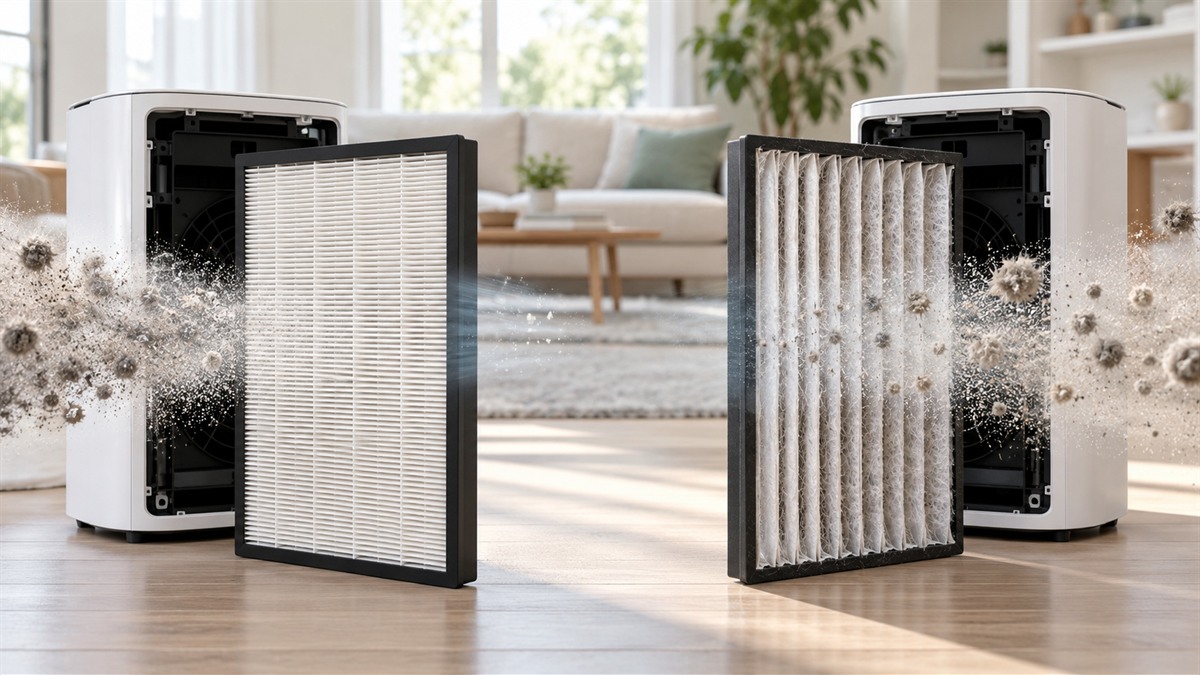
A True HEPA filter is one that the sources define as removing at least 99.97% of particles at 0.3 microns. “HEPA-type” and “HEPA-like” are not a defined standard, so they do not carry that promise. Look for the 99.97% at 0.3 microns figure itself, not the name on the box.
This guide compares the terms using pages we opened on 17 October 2026. The EPA and King County pages give the HEPA benchmark. Two consumer pages say the variant names have no standard behind them. One of those consumer pages is written by a company that sells air purifiers, and we label it that way. Neither government page we opened discusses “HEPA-type” by name, so the point about those names rests on the consumer pages. The filter’s rating and the unit’s airflow rating are separate questions, so the room-size section below covers the second one.
What the sources say the terms mean
- HEPA. The EPA says HEPA “is a type of pleated mechanical air filter that is common in portable air cleaners.” The acronym stands for “high efficiency particulate air” as officially defined by the U.S. Department of Energy.
- The benchmark. The EPA says a HEPA filter “can theoretically remove at least 99.97% of dust, pollen, mold, bacteria” at a particle size of 0.3 microns, and that 0.3 microns “corresponds to the worst case.” King County says to use “HEPA or True HEPA filters, meaning they are at least 99.97% effective at filtering particles as small as 0.3 microns.”
- True HEPA. A consumer blog, Vacuum Wars (last updated August 22, 2025), says “True HEPA” has “no legal or scientific meaning” and that it is a marketing term. It uses the 99.97% at 0.3 microns figure as the DOE benchmark.
- HEPA-type and HEPA-like. Vacuum Wars says these products “do not satisfy the HEPA standard” and often capture far fewer particles, sometimes around 90%. Molekule, a company that sells air purifiers, says “Calling a filter a HEPA Type filter is essentially meaningless, as it does not conform to any standard.” Molekule calls “HEPA-like” “just a marketing term”.
Where the sources agree and where they do not
- Agree: the 99.97% at 0.3 microns figure is the benchmark. The EPA, King County and Vacuum Wars all use it.
- Agree: “HEPA-type” and “HEPA-like” have no defined standard. Only the two consumer pages say so.
- Seller claim only: Molekule says no official HEPA certification program exists for consumer purifiers. The EPA and King County pages we opened say nothing about certification. Treat the certification point as Molekule’s view.
Worked example: 10,000 particles of 0.3 microns
Imagine 10,000 particles of 0.3 microns reaching a filter. A filter that captures 99.97% lets through 0.03% of them: 10,000 x 0.0003 = 3 particles. A filter that captures about 90%, the level Vacuum Wars gives as an example for some HEPA-type products, lets through 10% of them: 10,000 x 0.10 = 1,000 particles. The figures are our arithmetic. The 90% figure is an example from a consumer blog, not a test of any product.
How the filter rating relates to room size
A HEPA rating says how well each particle is caught. CADR says how much filtered air reaches the room each minute, and the two are separate numbers. For a room 12 ft wide and 14 ft long, King County’s ratio of 65 cfm per 100 sq ft gives about 109 cfm, which is our arithmetic. The EPA chart gives 130 cfm for 200 sq ft and 195 cfm for 300 sq ft, assuming ceilings of 8 feet. King County says CADRs above 200 cfm are better for larger spaces. A HEPA label does not tell you any of these figures, so check the CADR on the listing as well.
How to check a purifier before you buy
- Look for an explicit figure: “99.97% at 0.3 microns” on the spec or label. King County recommends HEPA or True HEPA filters on that basis.
- If the listing says only “HEPA-type” or “HEPA-like”, ask the seller for the test figure at 0.3 microns. The listing may not give one.
- Check the CADR and whether it is AHAM Verifide. King County advises checking the AHAM-verified CADR for the room size.
- Avoid add-ons. King County advises against ionization and UV features unless they are third-party verified, because of possible health hazards.
What the terms do not tell you
The HEPA definitions above are about particles. The EPA says the CADR rating system is for particles only, so a HEPA filter’s efficiency figure does not measure gases or odors. This guide makes no medical claim. A doctor decides what is right for any medical need, such as asthma or allergies.
Frequently asked questions
Is “True HEPA” a legal term?
Vacuum Wars says it has no legal or scientific meaning. The EPA and King County pages do not discuss the term.
Is HEPA-type the same as HEPA?
No defined standard supports that. The two consumer pages say HEPA-type does not meet the HEPA standard. Ask for the 99.97% at 0.3 microns figure to compare.
What particle size is the HEPA benchmark?
0.3 microns. The EPA says the 0.3 micron specification “corresponds to the worst case”.
Does a True HEPA filter remove odors?
The EPA and King County definitions are about particles. Odors and gases are a separate question. Check the listing for a carbon stage and for what it says it removes.
Sources
US EPA, What is a HEPA filter (last updated January 13, 2026; opened 17 October 2026).
King County, Washington, HEPA technology page (no page date shown; opened 17 October 2026).
Vacuum Wars, Not all HEPA filters are created equal (consumer blog; last updated August 22, 2025; opened 17 October 2026).
Molekule, True HEPA filter: what it is and what it isn’t (seller blog; Molekule sells air purifiers; published March 30, 2019, updated 2022; opened 17 October 2026).